

Summary
- SSHDs paired an HDD with a small NAND cache for faster speeds, but the idea didn’t work out.
- SSD prices fell rapidly, which made SSHDs vanish from the market.
- I’m nostalgic for SSHDs, but a proper comeback is unlikely.
A little over a decade ago, SSDs began to drop in price, making them a viable storage option for consumer PCs and offering significantly faster performance than traditional HDDs.
However, their cost remained several times higher than that of standard HDDs, prompting manufacturers to develop a new, hybrid solution: the SSHD. Unfortunately, it never quite lived up to its promise.
SSHDs overpromised and underdelivered
SSDs (Solid State Drives) are a type of drive that uses fast flash storage to store data. There’s a good chance you own one, as they’re the de facto standard in desktop and laptop PCs. More specifically, ultra-fast NVMe M.2 SSDs have become mainstream, though the slower SATA SSDs still have their place in older or more budget-friendly systems.
Credit: Corbin Davenport / How-To Geek
Before SSDs, we relied on HDDs (Hard Disk Drives), which store data on spinning magnetic disks called platters. HDDs are much slower than SSDs (even the most basic NVMe SSDs are 20 to 30 times faster), but they offer a far lower cost per gigabyte of storage.
Because of their low price, HDDs are still widely used for storing large files like photos, videos, and backups, especially when fast access isn’t critical. They also tend to be highly reliable, and data can often be recovered even if the drive fails. You might not have one in your PC, but many people use HDDs in their NAS (Network-Attached Storage).
Related
Please stop putting desktop hard drives in your NAS
Don’t start your NAS journey off on the wrong foot.
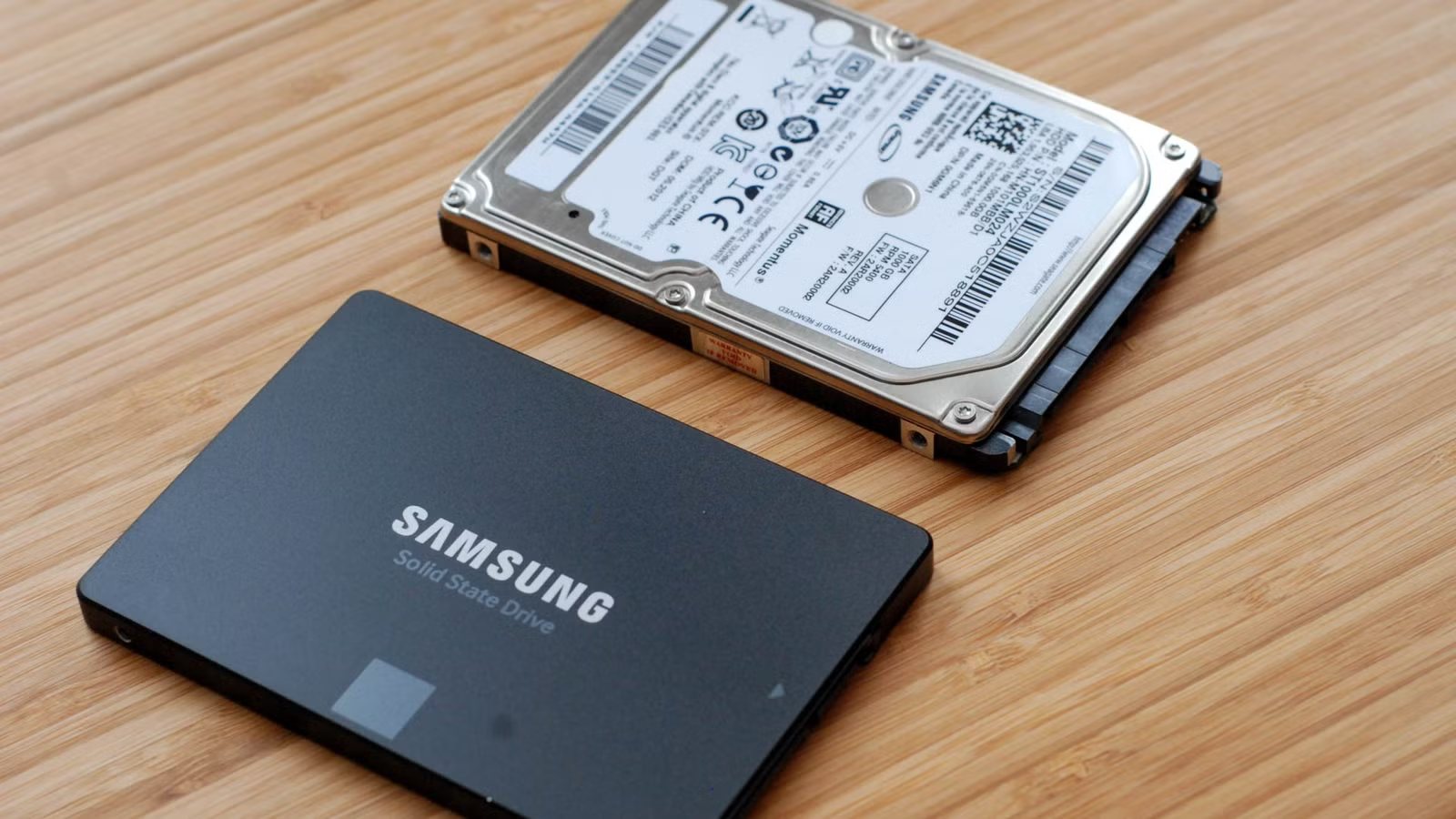
For a short time, there was a third type of storage called an “SSHD,” which stood for Solid-State Hybrid Drive. As the name suggests, it was a hybrid between an SSD and an HDD.
Essentially, it was a regular HDD with a small amount of NAND flash memory (like an SSD) built in to act as a cache for frequently accessed data.
The drive used an algorithm to determine frequently-accessed files. The drive would then automatically move files in and out of the cache, allowing for faster boot and application load times than a regular HDD without the cost of a full SSD.
While the idea sounded good on paper, the technology rarely lived up to it. Data on the NAND flash would constantly get overwritten, so most of the time, performance stayed at HDD levels. You’d only get close to SSD speeds when repeatedly loading the same app or booting your system several times in a row without opening anything else.
Instead of combining the best of both worlds, an SSHD mostly gave you the worst of both: a slow HDD with only occasional glimpses of SSD-like performance—like jumping quickly back into a match of League of Legends after the game crashed.
Worse still, because SSHDs still used platters for storage, they were loud and just as sensitive to shocks as regular HDDs. At the same time, the flash memory added complexity to data recovery in the event of a disk failure.
Credit: H_Ko/Shutterstock.com
SSDs getting cheap killed SSHDs
SATA SSDs slowly trickled into the mainstream consumer market in the late 2000s and early 2010s, but they were still quite expensive for the average user. That’s what made SSHDs appealing at the time—even if you couldn’t get the full speed of a real SSD, you could at least enjoy a slightly faster HDD without spending too much more.
However, year after year, SSD prices rapidly fell to the point where it was hard to justify not buying at least a 64GB SSD for your operating system, browser, and a few core apps, alongside a separate HDD for large files and games.
Credit: Ismar Hrnjicevic / How-To Geek
Being able to choose which apps got the benefit of faster load times was enough reason to opt for an SSD+HDD setup instead of an SSHD.
By 2016, SSDs were affordable enough that even I, a broke high-school student at the time, could save up and get a used 120GB SATA SSD for just $50. 120GB wasn’t a lot of storage even a decade ago, but it was enough to hold Windows, Chrome, and a couple of my favorite games.
SSDs continued to get drastically cheaper each year. They eventually became a viable complete replacement for old HDDs for people who don’t need a whole lot of storage and gamers who need ultra-fast loading speeds.
By the late 2010s and early 2020s, the vast majority of laptops, gaming PCs, and gaming consoles (like the Xbox Series S|X and PlayStation 5) shipped not just with SSDs, but with the much faster NVMe variety.
Credit: Lucas Gouveia / How-To Geek | Best Buy | Miguel Lagoa / Shutterstock
Now that SSDs are affordable for everyone, there’s simply no longer any reason for SSHDs, which is why they have quietly disappeared from the market.
The idea was cool, but the technology just couldn’t live up to the promise
Even though SSHDs ultimately failed as a product, I’m still a bit nostalgic about them—or, more precisely, the idea of them.
Although flash storage is cheap today, files have never been larger. A single video game can take up well over 100GB of disk space. Add some photos, videos, and perhaps a few Blu-Rays and lossless music files, and it’s easy to see how an average person can fill a ~$200 2TB NVMe drive in no time.
Credit: Patrick Campanale / How-To Geek
If SSHDs made a comeback and actually delivered on their promise while keeping prices reasonable, I’d be first in line to buy one. Unfortunately, that’s unlikely to happen, but one can still hope.
