

Follow ZDNET: Add us as a preferred source on Google.
Welcome to ZDNET’s “Breakthrough” Awards for 2025, our latest tradition that celebrates the most innovative and forward-thinking technologies to cross our editors’ desks this year.
Over the past 12 months, we’ve spent countless hours challenging the utility of foldable phones that dominated the mobile conversation, lived entire work weeks through the lens of new smart glasses and VR headsets, and benchmarked more robots than ever, from ones that can ideate and pull context through the lenses of our phones, to ones that can sweep, vacuum, mop, and accomplish every chore in between.
Also: The 40 best products we tested in 2025: Editors’ picks for phones, TVs, AI, and more
Amidst this relentless wave of maturing — yet, constantly innovating — product categories, identifying a true ‘Breakthrough’ has never been harder. These awards don’t just go to the fastest chipset or the most premium design; they go to the products that fundamentally changed the conversation, set a new bar for innovation, and showed us a glimpse of the technology that will define the rest of the decade.
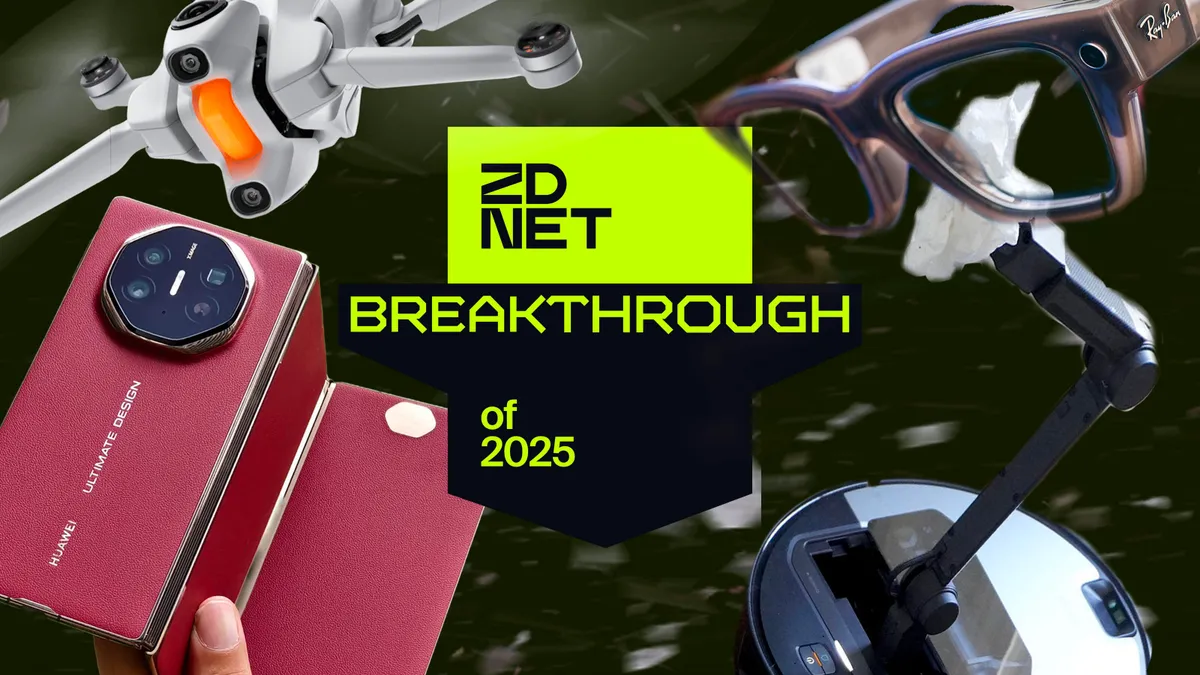
In no particular order, here are the recipients of the ZDNET Breakthrough Award for 2025.
1. Huawei Mate XT Ultimate: The first tri-foldable of many
Prakhar Khanna/ZDNET
While Samsung’s upcoming Galaxy Z TriFold continues to dominate the headlines at the end of the year, it was a competing tri-foldable phone that left the biggest footprint in 2025. The Huawei Mate XT Ultimate launched globally back in February and saw immediate fanfare. We witnessed the hype in person at Mobile World Congress in Barcelona, as hundreds of journalists, analysts, and tech enthusiasts flooded the Huawei booth to get a feel of the Chinese tech giant’s shape-shifting handset.
Also: I tested Huawei’s $3,600 tri-foldable phone – now I’m wondering why Samsung hasn’t made this yet
Unlike traditional foldable phones that can only bend at the center, the Huawei Mate XT Ultimate features two inward-folding hinges, converting a single 6.4-inch screen into a larger, tablet-like 10.2-inch display. The result is a true multimedia consumption device that can fit into pants pockets, backpack sleeves, and more.
While the lack of Google services was a notable caveat of the Huawei foldable, we found its general functionality and otherwise uncompromising feature set admirable.
ZDNET’s Prakhar Khanna put it best: “The Huawei Mate XT Ultimate sets a new benchmark for tri-fold phones, showing they’re no longer just experimental — but a bold step toward the future of mobile computing.”
2. Roborock Saros Z70: Literally a helping hand
Maria Diaz/ZDNET
Robot vacuums continue to play an essential role in thousands of households, but is there room to expand beyond vacuuming and mopping? Roborock put its money on “literally moving obstructions” in 2025 with the Saros Z70 model, and it left a lasting impression on ZDNET’s smart home expert, Maria Diaz.
Also: This viral Roborock with a robot arm is 25% off on Amazon – so it’s finally buy time for me
The Saros Z70 featured an OmniGrip mechanical arm capable of detecting and picking up lightweight objects, such as socks, tissues, and sandals, so long as they weighed under 300 grams. From our tests, the motorized feature was successful most of the time, though the automation required time and practice.
Thanks to a built-in camera, users can also remote-control the Saros Z70 from their phones, driving the vacuum while operating the mechanical arm like a claw machine.
“The Saros Z70 is the next level in robot vacuum technology, and it’s pioneering the idea of a functional, multipurpose household robot that you can truly rely on,” said Diaz, and that’s why it’s earned a place on ZDNET’s list of Breakthroughs this year.
3. Meta Ray-Ban Display: The next frontier of smart glasses
Kerry Wan/ZDNET
Riding on the popularity of Ray-Ban-branded smart glasses, Meta went for a homer this year when it launched the Ray-Ban Display at Connect. While the smart glasses retained essential features like hands-free photo and video capturing, they also introduced a waveguide, full-color display that projected contextual information — realizing the true multimodal capabilities of AI wearables.
Also: I tried the Meta Ray-Ban Display glasses, and they got me excited for the post-smartphone era
Through a companion accessory, an EMG neural wristband, users could navigate the floating interfaces with various hand gestures. Our team was able to learn and familiarize itself with the controls within minutes of testing. From then on, the Ray-Ban Display became a vehicle for ambient information, ranging from live captions during conversations to Meta AI responses and incoming notifications.
The Meta Ray-Ban Display’s bundle price remains a point of strength, selling for $799. Within the first weeks of release, the latest smart glasses saw reservation demos pushed back by months. The question now is how competitors like Google, Samsung, and possibly even Apple will respond in 2026.
4. Antigravity A1: A drone that never misses a shot
Cesar Cadenas/ZDNET
Antigravity, a sub-brand of popular camera maker Insta360, launched this summer, and its first product set the bar high. ZDNET’s Cesar Cadenas tested the A1 drone in Los Angeles and found its 360-degree video recording to be a game-changer for content creation. Effectively, you can never miss a shot with the A1’s 8K sensor, and its 249-gram weight falls just under the US government’s 250-gram limit for recreational drone-flying.
Also: I replaced my travel video gear with this 360-degree drone within minutes of testing it
The Antigravity A1 works in tandem with a Grip Controller and Vision Goggles, the latter of which provides the user with a first-person view of the drone’s sensors as they drift through the sky. Thanks to the goggles’ micro-OLED displays and commendably low-latency video streaming, Cadenas was left impressed with the full flight experience.
“Yes, it’s expensive [at $1,599], but I’d still recommend the A1 to anyone interested in drones. Its ease of use makes it great for newcomers, and creators will be impressed by the video quality,” said Cadenas.
