

Picture this: you’ve just moved into a beautiful basement apartment with exposed brick walls and loads of character. Within weeks, though, you notice a musty smell creeping in, and dark spots are appearing on the walls.
Or perhaps you have a different problem: you live in a humid climate where your clothes never quite seem to dry indoors, and your windows are constantly fogged with condensation.
You may like
How do dehumidifiers help in cold weather?
Suffering from damp caused by condensation during cold weather? Well, you’re not alone – this is a growing problem. One of the main causes is that modern homes are well-insulated and airtight, to keep heat in and energy bills down. But while that’s good for the environment, it has one unfortunate consequence.
The greater the temperature difference between your cozy, heated interior and the cold outdoors, the more likely that condensation will form on cold surfaces like windows and walls; especially in areas with poor ventilation (if you don’t open windows regularly). This effect is also marked if you only put the heating on intermittently which, given current energy prices, no one would blame you for.
(Image credit: Future)
Add to this the fact that tightly sealed homes trap moisture from everyday activities like cooking, showering and drying laundry, and you’ve got a recipe for condensation and damp. Ironically, then, the very features that make modern homes energy-efficient also make them more prone to humidity, which is why dehumidifiers have evolved from niche appliances to household essentials.
How do dehumidifiers help in hot weather?
Live in a climate that’s hot all year round? Then you may still have need for a dehumidifier. In regions such as the southern USA, the Caribbean or Southeast Asia, the outdoor air naturally contains a massive amount of moisture. But while air conditioning removes some humidity as a by-product of cooling, it often can’t handle the heavy moisture load by itself, leading to persistent indoor humidity.
This creates that sticky, uncomfortable feeling, forces your AC to work harder and less efficiently to reach the desired temperature, and provides the perfect breeding ground for mold and mildew in closets, crawl spaces and poorly ventilated rooms.
(Image credit: Getty Images)
What does a dehumidifier do?
A dehumidifier removes excess moisture from the air in your home, primarily to combat dampness and improve air quality.
In cold climates, it targets the moisture generated by daily activities (cooking, showering, drying laundry), which can lead to condensation on cold surfaces like windows and walls. By reducing the overall humidity, the dehumidifier prevents the formation of damp and mold.
In hot, humid climates, it combats the high, year-round moisture load coming from the outdoor air. By working alongside your air conditioning unit, a dehumidifier manages the persistent humidity that the latter often can’t handle alone. This allows the AC to cool more efficiently and creates a far drier, more comfortable indoor environment.
(Image credit: Getty Images)
How does a dehumidifier work?
Most dehumidifiers use a clever process that’s similar to how your refrigerator works. The most common type, a refrigerant or compressor dehumidifier, essentially sucks water out of the air through temperature manipulation.
A fan draws humid air into the machine, where it passes over a set of cold coils. When warm, moisture-laden air hits these chilled surfaces, the water vapor condenses into droplets (like how dew forms on grass in the morning). These water droplets drip down into a collection tank inside the unit.
The dehumidifier doesn’t, though, just blow cold air back into your room. Instead, it passes the dried air over warm coils, to gently reheat it to roughly room temperature before releasing it back into your space. This continuous cycle gradually reduces the overall humidity level in the room. The collected water can either accumulate in a removable tank that you empty manually or, in some models, drain away continuously through a hose.
How does a desiccant dehumidifier work?
While refrigerant dehumidifiers are the main type, there’s another type worth knowing about: desiccant dehumidifiers. Instead of using cold coils, these models use moisture-absorbing materials such as silica gel (those little packets you find in shoe boxes) to trap water vapor from the air.
Desiccant models – such as the Meaco DD8L Zambezi and EcoAir DD3 Classic – have some distinct advantages. They’re typically quieter and work better in colder temperatures, making them ideal for chilly basements or garages.
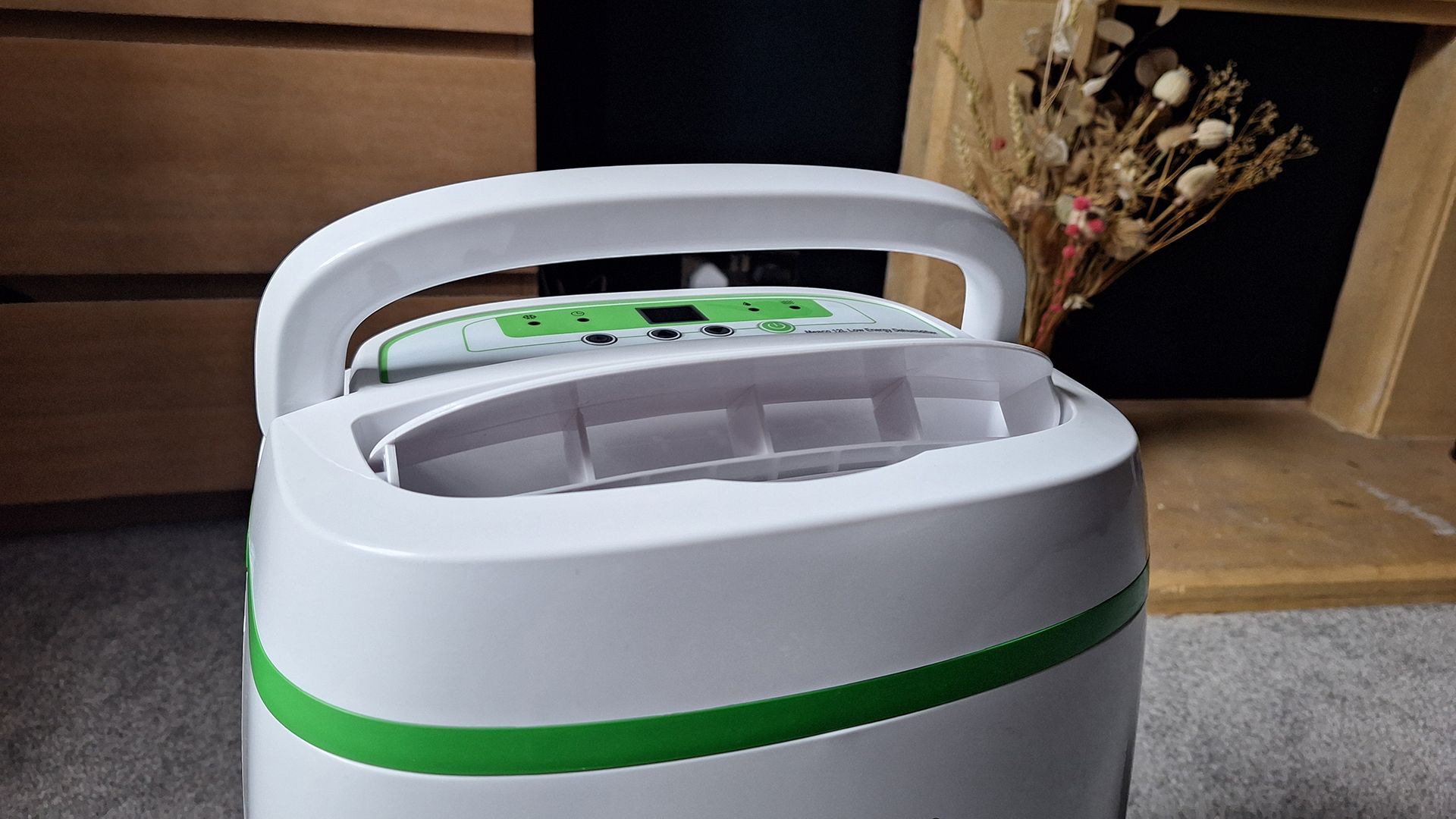
Refrigerant models, on the other hand – such as the Meaco 12L Low Energy Dehumidifier or the Honeywell TP SMALL 24L Portable Dehumidifier are generally more energy-efficient and work well in warmer conditions.
Today’s best Dehumidifiers deals
