

HTG Wrapped 2025: 24 days of tech
24 days of our favorite hardware, gadgets, and tech
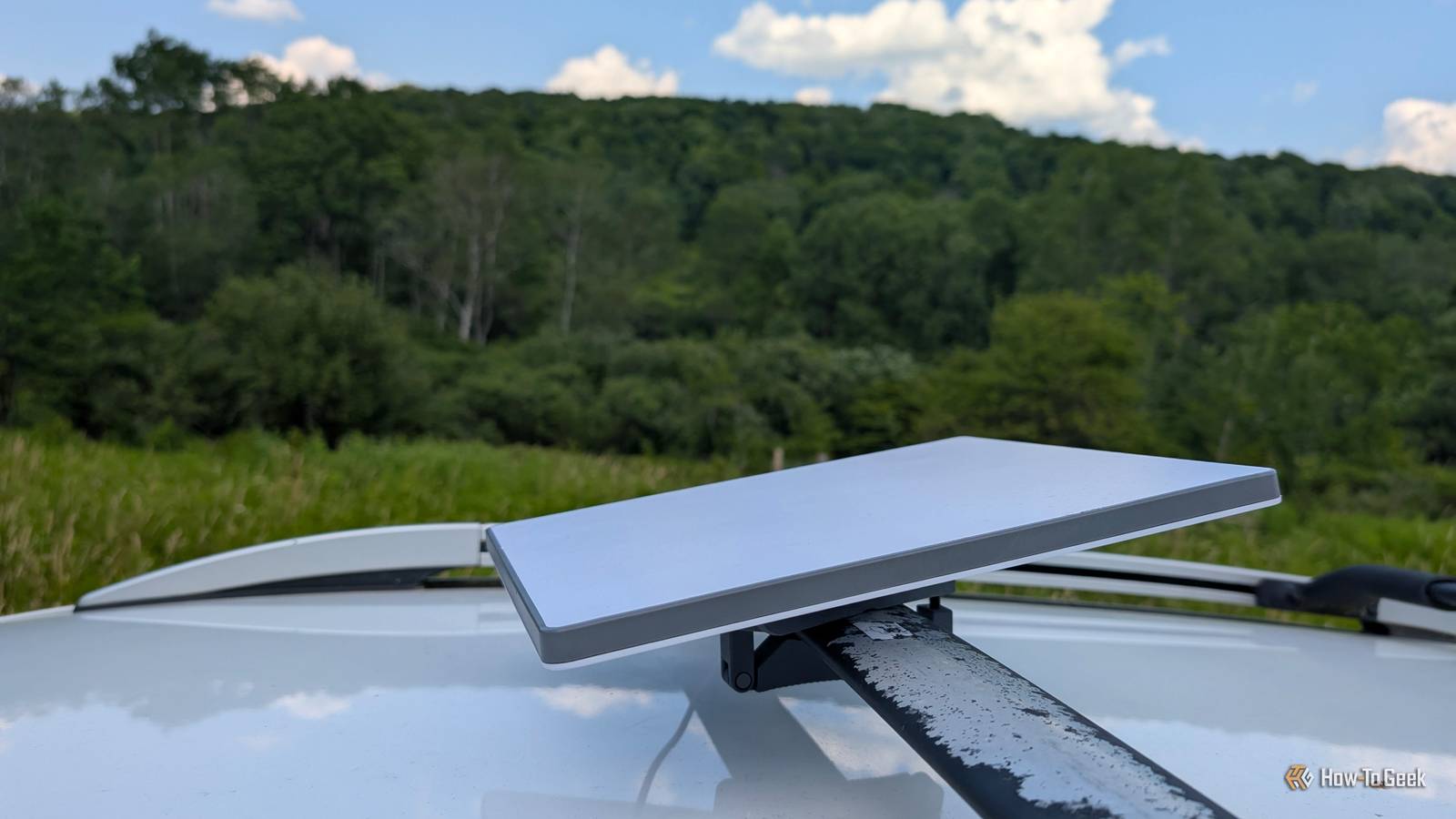
It isn’t every day that a new technology can be described as a paradigm shift, but Starlink is pretty close. Satellite internet, which used to be relatively slow and very high latency, is now competitive with broadband. My Starlink Mini has quickly become one of my favorite gadgets, and is my constant companion in my car.
I originally purchased the Starlink Mini because I was planning on taking a long road trip and working on the move, but it quickly became so much more than a luxury item. It wasn’t until I saw it in action while writing my review that I fully appreciated it.
Credit: Nick Lewis / How-To Geek
While driving at highway speeds, it was able to sustain download speeds of several hundred megabits per second and kept the latency below 50ms at all times. Even adverse conditions, like heavy rain and snow, don’t make it useless—just slower. I’ve put it through sub-zero (Fahrenheit) temperatures, torrential downpours, scalding hot days left in the sun, and it has been hit by more than a few rocks. A large dog jumped off a couch and landed directly on it. I’ve also accidentally dropped it off the top of my car twice. With everything it has been through, my Starlink Mini functions every bit as reliably as the day I took it out of the box—it just has a bit of cosmetic wear.
Despite being tasked with communicating with satellites in low-Earth orbit, the shoebox-sized antenna just sips power, which makes it an incredible tool in emergencies. A small household battery, like you might purchase from Bluetti, Jackery, EcoFlow, or Anker, could run it for several days—longer if you were careful to conserve power. If you have a few hundred watts of solar panels to add to the system, it could run indefinitely.
Related
Instead of a Powerwall, I Backed My Home Up With Tons of Solar Generators
It wasn’t cheap, but it was cheaper.
In an emergency situation, where communication through conventional means might be difficult or impossible, it could be used to call for help, receive important instructions, or even search for information on how to survive. If I lived in an area prone to natural disasters, especially something like hurricanes, I’d keep a Mini in my home’s emergency kit, too.
Once I realized the potential usefulness in an emergency, it became a permanent part of my car’s emergency kit. I also carry a small battery that has enough juice to run it for a few hours in the event that I’m stranded in the middle of nowhere with a broken-down vehicle.
The price of the Starlink Mini fluctuates between $230 and $500 for the antenna, but Starlink residential customers can sometimes get an even better deal than that.
At the moment, there are three plans available for the Starlink Mini: $5 per month for emergency-only access, $50 for 50 gigabytes of data, or $165 per month for unlimited data. Occasionally, the plans change as the Starlink satellite network is expanded and upgraded.
It isn’t often that I spend a few hundred dollars and don’t second guess the decision one bit, but the Starlink Mini is definitely one of those times. I’d buy it again in a heartbeat, especially when it’s below $300.
Brand
Starlink
Range
1,200 sq.ft
Wi-Fi Bands
802.11a/b/g/n/ac
Ethernet Ports
One Ethernet LAN port
MU-MIMO
Dual Band 3 x 3 MU-MIMO
Security
WPA2
HTG Wrapped 2025: 24 days of tech
24 days of our favorite hardware, gadgets, and tech
